
What a Phase I ESA is — and is not
A Phase I ESA examines records, interviews, and site conditions to identify potential environmental concerns. Sampling and laboratory analysis are generally additional investigative work. The need for that work depends on the project and professional judgment.
The assessment informs decisions about environmental conditions associated with a property. AAI is one requirement for certain CERCLA liability protections; it does not establish eligibility on its own.
Who needs one, and when
Lenders require a Phase I on most commercial real estate loans and on many refinances. Buyers order one for any acquisition, and increasingly for ground leases and long-term tenancies where the tenant may be treated as an operator. Public agencies, brownfield programs and SBA-backed loans have their own triggers, and some state programs layer additional requirements on top of the ASTM scope. The wider role of environmental due diligence in real estate transactions is covered in a separate post.
For acquisition-related AAI, check the dates of the individual components against the acquisition date. The rule specifies one year overall and 180 days for five components. Prior information can be considered subject to applicable update requirements. See our Phase I timing and review guide.
What ASTM E1527-21 requires
E1527-21 replaced E1527-13 and has been the version EPA references since February 2023. The scope has five parts, and each is a distinct piece of work.
Records review
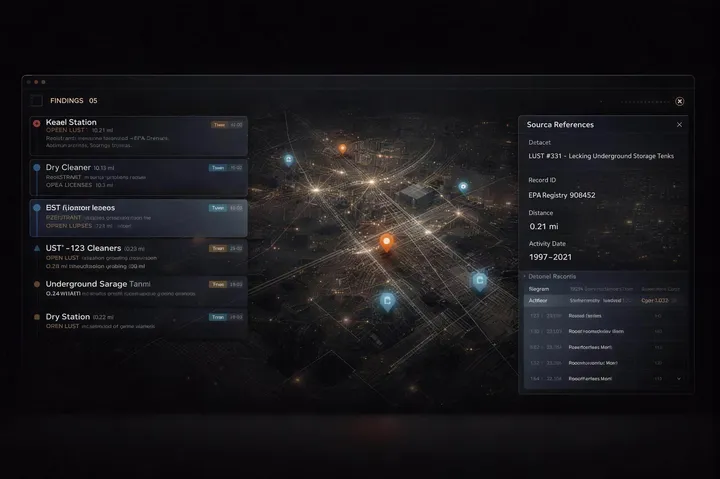
The Environmental Professional reviews relevant federal, tribal, state, and local government records and evaluates their significance for the subject property. Use the applicable standard to determine the required records and search distances.
Historical sources
The standard requires a good-faith effort to trace the property's use back to 1940 or to its first developed use, whichever is earlier. Aerial photographs, fire insurance maps, city directories, topographic maps and building department files are the usual sources. Evaluate relevant historical information about adjoining properties as part of the inquiry.
Site reconnaissance
The Environmental Professional, or someone under their supervision, walks the property and its perimeter, looks at the interiors of structures, and photographs what they see. Staining, drums, vent pipes, fill ports, sumps, pits, transformers, stressed vegetation and unexplained fill are the sort of observations that end up in the findings. Document the reconnaissance and any limitations in the report.

Interviews
The current owner, the occupant of the property, and in some cases past owners and neighbors are interviewed; local government agencies are contacted about permits, spills and fire department records. The user supplies information relevant to the inquiry, including specialized knowledge and other matters addressed in 40 CFR 312.22.

The report and the declaration
Everything above is documented in a written report with a findings section, an opinion, a conclusion, a statement of deviations and data gaps, and the qualifications of the Environmental Professional. The EP signs a declaration that they meet the definition in 40 CFR 312.10 and that the work was done in conformance with the standard. Appendix X5 of E1527-21 provides a suggested table of contents and report format; see the publisher’s overview, section 4.10.
How findings are classified
Use the applicable standard’s definitions when classifying conditions.
REC, HREC, CREC, and de minimis are classifications to evaluate using the standard’s full definitions. For past releases, review the closure evidence, applicable criteria, and any continuing controls or limitations. This overview is not a substitute for those definitions or the Environmental Professional’s classification.
Closure documents and current information matter when reviewing historical or controlled conditions. Our ASTM E1527-21 review guide covers timing, closure-evidence questions, data gaps, and PFAS scope.
Significant data gaps need an explanation of their effect on the assessment. PFAS should not be treated as categorically outside scope: EPA designated PFOA and PFOS, including their salts and structural isomers, as CERCLA hazardous substances. See EPA’s designation page. Confirm the substances, applicable requirements, and agreed project scope.
What a good report looks like
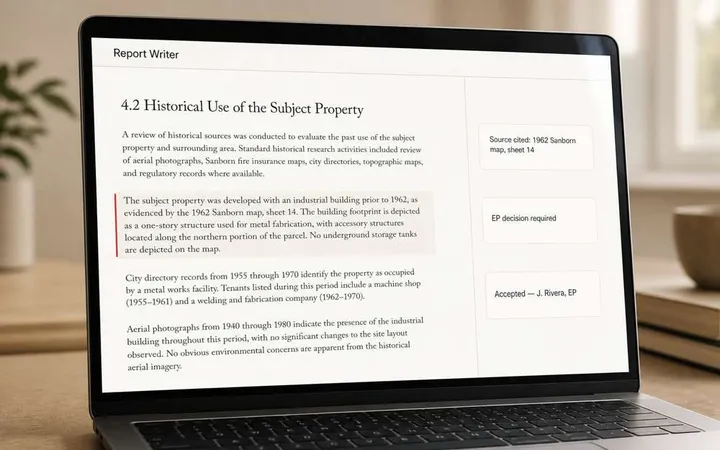
Two Phase I reports on the same property can reach the same conclusion and still be of very different quality. The difference is usually traceability. A strong report lets the reader follow every finding back to the record, photograph, map or interview that supports it, states what was not found as clearly as what was, and keeps the EP's opinion separate from the raw data.
A useful review checks that sources are identified, observations and interviews are documented, and opinions explain the supporting evidence. Significant data gaps should be discussed alongside their effect on the assessment.
Where the time goes
The schedule depends on site access, records availability, project scope, and review. Agree on the delivery date with the assessment provider and leave time to resolve missing information and review the report.
The report-writing stage is repetitive in a way that fieldwork is not. Every report has the same sections; the same kinds of records are read and summarized; and the same judgments are made about what rises to a REC. Firms producing several reports a month feel this most, because the writing is where senior time goes and where turnaround slips.
Where AI fits in 2026

AI tools have been marketed to environmental consultants for several years, and the useful ones have settled into a few roles: screening a parcel before a Phase I is commissioned, searching a firm's own library of past reports, and drafting report sections from source material. Our comparison of the Phase I ESA software stack explains what each category does. The question that matters for a Phase I is not whether a tool can produce text but whether an EP can defend what it produced, which is the subject of our guide to defensible AI for Phase I ESAs.
That is the standard FlipType's AI Phase I ESA Report Writer was built to. The EP builds the Phase I inside the application, working from the firm's own materials — its previous reports, research notes and field reports. The tool produces a structured draft with source references for professional review. The EP checks the supporting records, identifies missing information, and corrects unsupported statements before finalizing the report. The EP reviews, edits and signs, and the finished report exports as a Word document in the firm's own template. Each firm's data lives in its own isolated tenant on Microsoft Azure.
Drafting is about 80% quicker than writing the report by hand. The assessment itself — the walk, the interviews, the professional judgment — does not change. What changes is how long it takes to get the judgment onto the page with its evidence attached.